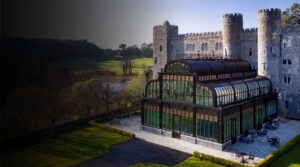
Every year, hundreds of thousands of visitors climb the narrow, worn steps of Blarney Castle, lean backwards over a sheer drop, and kiss a slab of limestone set into the battlements. It’s one of the strangest rituals in world tourism — and one of the most enduring. But where did the legend of the Blarney Stone actually come from, and why has “kissing a rock” survived as a bucket-list moment for over two centuries? The answer is part history, part folklore, and part very clever 19th-century marketing.
What Is the Blarney Stone?
The Blarney Stone is a block of limestone built into the battlements of Blarney Castle, near Cork city. Tradition holds that kissing it grants the “gift of the gab” — eloquence, wit, and the persuasive charm the Irish are famously associated with. To do it, visitors lie on their back, hold onto iron rails, and lean backwards over a gap in the parapet, assisted by a castle attendant who has done this thousands of times before. It looks more dangerous than it is, but it’s precisely that mild thrill that keeps the tradition alive.
The Legend of the Gift of Gab
The core legend is simple: whoever kisses the stone will never again be lost for words. Where that specific idea came from is murkier. One popular story credits Cormac MacCarthy, the Lord of Blarney, who is said to have used such eloquent, evasive language while negotiating with Queen Elizabeth I’s officials that she reportedly dismissed his endless flattering promises as “a lot of Blarney” — meaning talk that sounds convincing but commits to nothing. The word “blarney,” meaning charming, persuasive talk that isn’t quite trustworthy, entered the English language directly because of this castle.
Origin Stories: Which Legend Is True?
Beyond the MacCarthy story, several older, more mythic origins are attached to the stone. One version claims it’s half of the Stone of Scone, Scotland’s ancient coronation stone, gifted to an Irish king who supported Robert the Bruce. Another says it was the stone Jacob used as a pillow in the Book of Genesis, brought to Ireland over centuries of legend and trade. A third holds that it was given to Cormac MacCarthy by the goddess Clíodhna in return for his help, imbuing it with the power of persuasion. None of these can be proven — and that’s rather the point. Genuine folklore rarely has a single tidy source, and the Blarney Stone’s tangle of competing legends is part of what has kept it culturally alive for so long. Each version has been retold, embellished, and reprinted by generations of guidebook writers, which has only added new layers to a story that was never meant to have one fixed ending.
How to Kiss the Blarney Stone
The ritual itself hasn’t changed much in over a century. Visitors climb the spiral stone staircase to the top of the castle, queue at the battlements, then lie on their back and lean backwards over the parapet gap while an attendant holds their legs for safety. It’s over in seconds, and most people leave laughing rather than shaken. Sensible shoes are worth the effort — the staircase is narrow, uneven, and can get slippery in wet weather, which in Cork is often. Photography is allowed throughout, so it’s worth asking the attendant to snap a photo mid-lean before you climb back up.
Inside Blarney Castle
The stone gets the headlines, but Blarney Castle itself is a genuinely impressive 15th-century tower house, built in 1446 by Cormac MacCarthy on the site of two earlier fortifications. Visitors can explore the Great Hall, family quarters, kitchens, and a series of narrow passages and dungeons that reveal just how central defence was to castle design in medieval Ireland. The climb to the top rewards visitors with sweeping views over the surrounding parkland and gardens, stone-kissing entirely aside. On a clear day the views stretch well beyond the estate itself, out over the surrounding County Cork countryside.
The Rock Close and Blarney’s Gardens
Surrounding the castle, the Rock Close gardens are worth at least as much time as the tower itself. This atmospheric, tree-covered garden is dotted with ancient rock formations, a druid’s cave, and a wishing steps staircase, all wrapped in their own layer of folklore about fairies and druidic ritual. The wider Blarney estate also includes a poison garden, an arboretum, and formal gardens that make the site a full afternoon out rather than a quick photo stop. The poison garden in particular, stocked with genuinely toxic plants kept safely behind cages, has become one of the estate’s most talked-about additions in recent years.
Blarney Castle Through the Centuries
Blarney has passed through several rebuilding phases since 1446, surviving Cromwellian sieges in the 17th century and changing hands between the MacCarthy family and later owners over the following centuries of Irish history. Much of what stands today reflects those later medieval and early modern adaptations rather than a single untouched structure — a reminder that Irish castles were living, evolving buildings for centuries, not static monuments.
Common Myths and Misconceptions
A few myths persist around the stone that are worth clearing up. It is not, despite one popular claim, coated in anything unusual to explain its supposed power — its effect, if it has one, is entirely a matter of belief and tradition. It’s also not particularly dangerous; the safety rails and attendants have made the ritual safe for well over a century, even if the view straight down looks alarming in the moment for first-time visitors. And no, there’s no verified record of exactly which stone in the tangle of legends is the “real” one — which is, again, part of the charm, and half the fun of visiting is hearing a guide’s own take on the debate.
Tips for Visiting Blarney Castle
Arrive early or late in the day to avoid the worst of the coach-tour queues, which can otherwise stretch to well over an hour at the stone itself in peak season. Wear closed, flat shoes for the staircase, and budget at least two to three hours to properly see the castle, Rock Close, and gardens rather than rushing straight to the parapet. Blarney sits close enough to Cork city and the Ancient East route to pair naturally with other castle stops on the same day, making it easy to combine with Cahir or the Rock of Cashel further along the same road.
Why Blarney Still Captivates Visitors Today
Blarney endures because it offers something rarer than a good photo: a genuine, slightly absurd shared ritual that connects every visitor to centuries of the same tradition. Kissing the stone isn’t really about believing you’ll gain the gift of the gab — it’s about taking part in a piece of living folklore that has drawn visitors, kings, and writers alike since at least the 18th century. A private driver-guide who knows the layers of legend behind the stone — MacCarthy’s diplomacy, the Stone of Scone theory, the Rock Close’s druidic lore — turns a five-minute photo opportunity into a genuinely rich piece of Irish history. Blarney fits naturally into both Ireland’s Ancient East Castle Experience and Ireland’s Legendary Castle Trail, or browse the full Castle Tours lineup to plan your own route.