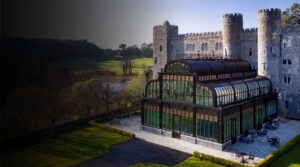
Ireland doesn’t do quiet history. Every stone keep and ivy-choked ruin seems to carry a story darker than the last, and nowhere is that more true than in the country’s castles. Centuries of clan warfare, betrayal, plague, and tragedy have left behind more than crumbling towers — they’ve left behind legends that refuse to fade. Long before “dark tourism” was a phrase, Irish families were already telling ghost stories around the fire about the castle down the road. Here are the fortresses where those stories are loudest, and where you can still feel the chill for yourself.
Why Ireland’s Castles Are So Rich in Ghost Stories
Ireland has more castles per square mile than almost anywhere in Europe, and most of them were built for one purpose: survival. Norman lords, Gaelic chieftains, and English planters all fought bitterly over the same land for eight centuries, and castles were where that violence concentrated. Sieges, executions, family feuds, and famine all played out within these walls, often generation after generation in the same building. Add in Ireland’s deep oral storytelling tradition — where a good tale was passed down more faithfully than any written record — and you get a country where nearly every castle has its own resident spirit, its own tragic maiden, and its own unexplained cold spot that locals will happily point out to you. Many of these stories were kept alive for generations by families who lived alongside the ruins long before any of them became tourist attractions.
Leap Castle: The Most Haunted Castle in Ireland
In County Offaly, Leap Castle carries a reputation that no other Irish castle can quite match. Built by the O’Carroll clan, it was the site of a chieftain reportedly killed by his own brother at the altar of the castle chapel, giving the room its lasting name: the Bloody Chapel. In the early 1900s, renovation workers clearing a hidden oubliette beneath the chapel found human remains packed so deep it took cartloads to clear them out. The castle’s most famous resident is the Red Lady, a spectral figure said to appear clutching a dagger. Today the castle is privately owned but open for tours, and paranormal investigators still request overnight access.
Malahide Castle and the Ghost of Puck
Just north of Dublin, Malahide Castle has stood for over 800 years, and its best-known ghost is a far gentler one than Leap’s. Puck was a jester in service to the Talbot family who reportedly fell in love with a noblewoman above his station. Murdered for it, he is said to have vowed to haunt the castle forever — and visitors still report catching his shadowy figure in photographs taken in the Great Hall. Malahide is also said to host a Lady in White and the ghost of Miles Corbett, a Cromwellian soldier executed for his crimes, whose apparition supposedly appears in full armour before collapsing into pieces. By day, Malahide’s gardens and demesne make it one of the most family-friendly stops in Dublin — the ghost stories are simply a bonus.
Charleville Castle’s Restless Spirits
Charleville Castle, a Gothic Revival masterpiece near Tullamore, has one of Ireland’s most heartbreaking castle legends. In the 19th century, a young girl named Harriet, daughter of the Earl of Charleville, lost her life sliding down the castle’s grand banister. Visitors and staff have long reported hearing a child’s laughter on the staircase and feeling an unexplained presence brush past them on the steps. Charleville sits alongside Leap Castle in County Offaly, a stretch of the midlands so associated with the supernatural that locals half-jokingly call it Ireland’s most haunted county.
Kilkenny Castle’s Quiet Hauntings
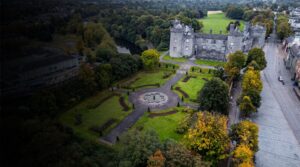
Not every haunted castle needs a violent legend to feel unsettling. Kilkenny Castle, seat of the powerful Butler family for nearly 600 years, is said to be haunted by the White Lady — believed by some to be Lady Margaret Butler, grandmother of Anne Boleyn. Unlike the dramatic hauntings elsewhere, Kilkenny’s ghost stories are subtler: cold drafts in empty corridors, a sense of being watched in the long gallery, footsteps on stairs when no one else is in the building. Given the centuries of political intrigue that passed through Kilkenny Castle, it would almost be more surprising if nothing lingered, and staff have long swapped stories about the same handful of rooms feeling noticeably colder than the rest of the building.
Ross Castle and the Legends of Lough Leane
Ross Castle, on the shores of Killarney’s Lough Leane, is best known as one of the last Irish strongholds to fall during the Cromwellian conquest — but local legend adds a supernatural layer to that history. Folklore holds that Ireland’s last High King, O’Donoghue, still rides a white horse across the lake on the first morning of May, and that the castle’s grounds hold echoes of the siege that finally brought it down. Set against the mountains of Killarney, Ross Castle proves that a haunted reputation and a jaw-dropping setting aren’t mutually exclusive.
Dunluce Castle: The Castle That Fell Into the Sea
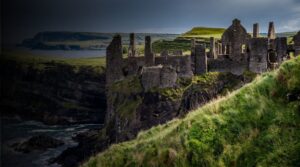
Perched dramatically on a cliff edge in County Antrim, Dunluce Castle needs no exaggeration to feel eerie — part of its kitchen genuinely collapsed into the sea below during a storm in the 17th century, taking several servants with it. Locals say the castle’s cook can still be heard wailing on stormy nights, and that the sound of the sea crashing against the rocks below carries echoes of that night. Dunluce’s ruined, wind-battered silhouette has made it one of the most photographed castles in Northern Ireland, ghost stories aside.
Huntington Castle and the Vault of Bones
Tucked away in County Carlow, Huntington Castle is less famous than Leap or Malahide, but no less unsettling. Beneath the castle lies a crypt containing centuries-old remains, and the building has long been associated with the Fellowship of Isis, a spiritual organisation founded by the family who once lived there. Visitors on tours of the vaults describe an unmistakable heaviness in the air — whether that’s history, atmosphere, or something else is left for each visitor to decide.
What Makes Irish Ghost Legends Different from Other Folklore
What sets Irish castle ghost stories apart is how tightly they’re woven into real, documented history. These aren’t generic “phantom knight” tales bolted onto old buildings for tourists — Harriet’s fall at Charleville, the executions at Leap, the Butler family’s centuries at Kilkenny are all matters of historical record. The ghost stories grew directly out of real tragedy, which is exactly why they’ve endured for centuries rather than fading into generic folklore. It’s also why so many of these legends feel less like campfire tales and more like unfinished history.
Experiencing Ireland’s Haunted Castles for Yourself
Reading about the Red Lady of Leap Castle is one thing — standing in the Bloody Chapel with a driver-guide who knows every layer of the story is another entirely. Desmond Tours’ Ireland’s Haunted Castles & Ghost Stories Tour is a five-day private journey built specifically around the country’s darkest legends, with overnight stays chosen for atmosphere as much as comfort. If you’d rather build your own route around Ireland’s castles, haunted or otherwise, the Castle Tours hub has the full lineup of private, driver-guided options.