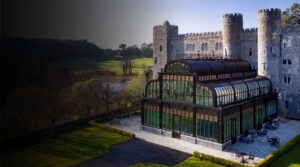
There’s a particular kind of beauty in a castle left to fall apart slowly, entirely on its own terms and timeline. Ireland’s countryside is scattered with ruins like this — roofless towers, collapsed curtain walls, and ivy-choked keeps standing in fields with no ticket booth or gift shop in sight, often reachable only by a short walk down an unmarked farm track. These are some of the finest, and most photogenic, ruined castles the country has to offer.
Why Ireland’s Ruined Castles Are So Captivating
Ireland never quite lost the habit of building castles and then, a few centuries later, walking away from them. Wars, changing fashions, absentee landlords, and simple economics left hundreds of once-powerful fortresses to the elements rather than to restoration, and the damp Irish climate has been remarkably efficient at reclaiming them ever since. The result is a landscape where a ruined tower house appears around almost every second bend of a country road, and where a handful of the very best ruins have become genuinely iconic without a single modern addition to soften their edges. Many are freely accessible year-round, with no ticket office or opening hours to plan around at all.
Dunluce Castle: Suspended Over the Sea
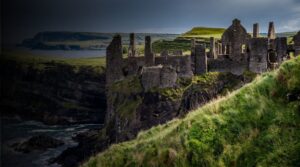
Dunluce, on the cliffs of County Antrim, is Ireland’s most dramatically sited ruin. Part of its kitchen and staff quarters genuinely collapsed into the Atlantic during a storm in the 17th century, and what remains today is a roofless, wind-battered shell perched right at the cliff edge, with the sea audibly crashing beneath it. Its state of preserved decay — enough structure to read the original layout, not enough to feel restored — is exactly what makes it one of the most photographed ruins in Ireland, and its dramatic history has inspired everything from folk songs to fantasy television.
Ferns Castle and the Seat of Leinster’s Kings
Ferns Castle in County Wexford stands on the site of what was once the royal seat of the Kings of Leinster, including Diarmait Mac Murchada, the king whose invitation brought the Normans to Ireland in 1169. The surviving 13th-century castle, with its distinctive corner towers, is a quieter, far less-visited ruin than either Dunluce or the Rock of Dunamase, but its direct connection to the very start of the Norman story in Ireland gives it outsized historical weight for its size, and its rural setting means visitors often have the whole site to themselves.
Dunamase Castle: A Fortress on the Rock
Rock of Dunamase, in County Laois, sits atop a limestone outcrop visible for miles across the surrounding plains, its ruined walls following the natural contours of the rock beneath them in a way few other Irish ruins manage. Once a stronghold connected to the same Diarmait Mac Murchada lineage as Ferns, Dunamase was largely destroyed by Cromwellian forces in the 17th century and never rebuilt afterwards, leaving a raw, open ruin that visitors can climb and explore far more freely than most intact castle sites allow, with panoramic views over the surrounding farmland as a reward for the short climb.
Roscommon Castle’s Silent Halls
Roscommon Castle, built in the late 13th century, stands roofless in a public park at the edge of Roscommon town, its four corner towers still largely intact despite centuries of exposure. Unlike more famous ruins, Roscommon Castle sees relatively few visitors, giving those who do make the trip a rare chance to explore a genuinely significant medieval ruin in near-total quiet, with only birdsong and the surrounding parkland for company.
Aughnanure Castle in the Woods of Connemara
Aughnanure Castle, near Oughterard in County Galway, is a well-preserved 16th-century tower house belonging to the O’Flaherty clan, set dramatically among trees on the banks of Lough Corrib, close enough to Galway city for an easy half-day visit. Its narrow spiral staircases, murder hole, and even a rare “bawn” fortification wall survive in unusually good condition for a tower house of its age, making it one of the best examples of how Ireland’s Gaelic lordships built and defended their own strongholds, distinct from the larger Norman keeps further east. The surrounding woodland setting also makes it one of the more atmospheric ruins to visit on a misty morning.
Black Castle, Wicklow
Perched above the sea on the edge of Wicklow town, Black Castle is little more today than fragments of stone wall clinging to a rocky headland, but its setting does most of the work. Built originally by the Fitzgerald family in the 13th century and destroyed more than once over the centuries that followed, what remains now serves as a dramatic, free-to-visit viewpoint over the Irish Sea rather than a formal heritage attraction — proof that a ruin doesn’t need much structure left to be worth the stop, especially at sunrise when the light catches the water below.
Photographing Ireland’s Castle Ruins
Ruined castles reward a very different kind of photography than intact ones — early morning or late evening light, when long shadows pick out the texture of broken stonework, tends to outperform the flat light of midday. Coastal ruins like Dunluce or Black Castle benefit enormously from stormy or overcast conditions that most visitors would otherwise consider “bad” weather, since dramatic skies suit a ruin’s atmosphere far better than a clear blue one, and Ireland’s changeable weather rarely leaves photographers waiting long for the right conditions. Wide-angle shots from a distance tend to capture the setting best, while closer detail shots of ivy, stonework, and empty window openings capture the texture up close. Arriving before the first coach tours of the day is often the simplest way to get a ruin entirely to yourself for photographs.
Conservation and the Future of Ireland’s Ruins
Not every ruin is left entirely to nature — sites like Dunamase and Ferns have received careful stabilisation work from the Office of Public Works to keep walls safe for visitors without fully restoring them, a deliberate middle path between collapse and reconstruction. This approach, sometimes called “conserved as found,” aims to freeze a ruin’s decay at a safe point rather than turn it into a fully rebuilt attraction, preserving the atmosphere that draws visitors in the first place. It’s a deliberately restrained approach compared with how many other European countries treat their own medieval ruins.
Seeing Ireland’s Ruined Castles on a Private Tour
Ireland’s best ruins tend to sit in exactly the places public transport doesn’t reach — clifftops, rural parklands, and quiet limestone outcrops well outside the main coach-tour circuit. A private driver-guide can reach these sites directly, time visits around the best light for photography, and connect the historical threads between them — Ferns to Dunamase, Norman keep to Gaelic tower house — in a way a self-drive itinerary rarely manages on a first visit, especially when travel times between remote sites need to be planned around opening light rather than opening hours.
Several of Ireland’s finest ruins feature on Desmond Tours’ Ireland’s Legendary Castle Trail, and atmospheric ruins with darker histories also appear on the Ireland’s Haunted Castles & Ghost Stories Tour, both built around private timing rather than a fixed coach schedule. See the full Castle Tours lineup to plan your own route among Ireland’s finest ruins.