Few Irish cities wear their history as visibly as Kilkenny. Walk from the castle to the cathedral and you’re tracing roughly a thousand years of continuous urban life, with medieval stonework, narrow laneways, and a genuine castle anchoring the whole city centre, all within a compact core that’s easy to cover comfortably on foot in a single visit. Kilkenny earns its reputation as Ireland’s medieval capital honestly — this is a guide to seeing it properly.
Why Kilkenny Is Called Ireland’s Medieval Capital
Kilkenny grew up around a 12th-century Norman stronghold and by the medieval period had become one of Ireland’s most important cities, home to a parliament that sat here in the 14th and 15th centuries and even, briefly, functioning as Ireland’s capital in the 1640s under the Confederation of Kilkenny, a period that left a lasting mark on the city’s civic buildings. Unlike many Irish cities where medieval layers were built over or demolished, Kilkenny’s compact centre kept much of its original street pattern and stonework intact, which is exactly why the “medieval capital” title has stuck. Later industrial growth largely bypassed the city centre, which is part of why so much of its medieval fabric survived into the present day.
Kilkenny Castle: The City’s Crown Jewel
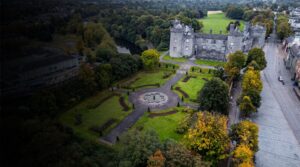
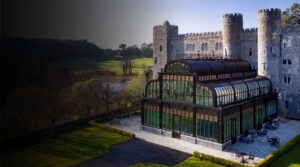
Kilkenny Castle sits at the heart of the city, having served as the seat of the powerful Butler family for close to 600 years. Unlike many Irish castles reduced to ruins, Kilkenny Castle survives largely intact, its state rooms, portrait gallery, and formal parkland open to visitors today. The castle’s long library, ornate ceilings, and riverside setting on the Nore make it one of the most complete castle interiors anywhere in the country, and its surrounding parkland gives the whole city a genuine green lung right at its centre. Guided tours take in the Butler family’s private apartments as well as the grander state rooms, giving a fuller sense of how the family actually lived day to day.
Walking the Medieval Mile
Kilkenny’s Medieval Mile links Kilkenny Castle to St. Canice’s Cathedral along a walkable route packed with historic buildings, laneways, and preserved medieval architecture. Along the way, look out for the surviving stretches of the old city walls, medieval townhouses tucked between newer shopfronts, and the narrow “slips” — pedestrian laneways connecting the main streets that have barely changed shape since the medieval period. It’s one of the few places in Ireland where you can walk an entire historic city core in under an hour and see genuine medieval fabric the whole way. Look up as you go — many upper-storey windows and rooflines along the route still follow their original medieval proportions, even where ground-floor shopfronts have been modernised.
St. Canice’s Cathedral and Round Tower
At the far end of the Medieval Mile, St. Canice’s Cathedral dates largely from the 13th century and stands beside one of only two round towers in Ireland that visitors can still climb. The 9th-century round tower predates the cathedral itself by several centuries and offers a genuinely rare chance to physically ascend one of these iconic early medieval structures, rewarding the climb with sweeping views across Kilkenny’s rooftops. The cathedral’s interior also holds one of the largest collections of medieval grave slabs and monuments found anywhere in Ireland.
Kyteler’s Inn and Kilkenny’s Witch Trial
Kilkenny’s medieval history isn’t all castles and cathedrals — it includes one of Ireland’s most notorious witch trials. Alice Kyteler was accused of witchcraft in 1324 after a string of her husbands died in suspicious circumstances, in a case that became one of the first recorded witchcraft trials in Ireland. She fled before facing execution, but her maidservant Petronilla de Meath was burned at the stake in her place, in what’s believed to be the first such execution in Ireland. Kyteler’s Inn, said to have been her home, still operates today as a pub and restaurant in the city centre, and the case is still studied today as one of the earliest documented witchcraft trials anywhere in Europe.
The Smithwick’s Experience and Kilkenny’s Brewing Heritage
Kilkenny’s brewing history runs almost as deep as its medieval one — Smithwick’s, Ireland’s oldest ale, has been brewed in the city since 1710, on a site with monastic brewing roots stretching back even further to a Franciscan abbey. The Smithwick’s Experience tells that story through the ruins of the old abbey and brewery buildings, giving visitors a genuinely different angle on the city’s history than the castle-and-cathedral trail alone, with a tasting included at the end of the tour.
Rothe House and Kilkenny’s Merchant Past
Rothe House is one of the best-preserved Tudor merchant townhouses in Ireland, built in the early 17th century by a wealthy Kilkenny merchant family. Its three linked courtyards and period rooms give a rare glimpse into how Kilkenny’s merchant class — as opposed to its aristocratic Butler family — actually lived, and its walled garden has been restored to reflect a genuine 17th-century layout. The house also holds a genealogical research centre for visitors tracing Kilkenny family history.
Where to Eat and Stay in Kilkenny
Kilkenny’s compact centre makes it an easy city to explore on foot, with a strong concentration of restaurants, pubs, and cafés built into medieval-era buildings along the Medieval Mile. Accommodation ranges from boutique guesthouses within the historic core to countryside options just outside the city, making it easy to base a night or two here as an anchor point for exploring Ireland’s Ancient East more broadly. Local specialties worth seeking out include Kilkenny lamb and the city’s own craft beer scene, which has grown well beyond Smithwick’s in recent years.
Day Trips from Kilkenny
Kilkenny’s location makes it an ideal base for exploring the wider region — Jerpoint Abbey, Dunmore Cave, and the medieval town of Thomastown all sit within a short drive, alongside further castle sites across Counties Kilkenny, Carlow, and Tipperary, giving visitors a genuine mix of monastic ruins, show caves, and market towns to explore beyond the city itself. Its central position within Ireland’s Ancient East makes it one of the easiest cities in the country to combine with a broader multi-day castle itinerary rather than treating it as a standalone stop, with several of the region’s finest Norman and monastic ruins reachable within thirty minutes of the city.
Planning Your Visit to Kilkenny
A single day covers the essentials — the castle, the Medieval Mile, and the cathedral — but Kilkenny genuinely rewards a longer stay, especially for visitors interested in the city’s brewing, merchant, and witch-trial history alongside its castle. Because so much of Kilkenny’s history is packed into a compact, walkable centre, it pairs naturally with a private driver-guide who can weave the castle, cathedral, and lesser-known stories like Kyteler’s trial into one continuous narrative rather than a checklist of stops. That same guide can also time a visit around the quieter parts of the day, since the Medieval Mile gets noticeably busier once coach tours arrive from Dublin.
Kilkenny remains a central stop on Desmond Tours’ Ireland’s Legendary Castle Trail and features throughout Ireland’s Ancient East Castle Experience. Browse the full Castle Tours lineup to see exactly how Kilkenny fits into a wider private itinerary alongside the rest of the region’s castles.