Long before Ireland’s castle hotels and photogenic ruins became bucket-list stops, castles served a far blunter purpose: control. When the Normans arrived in Ireland in 1169, they brought with them a technology of conquest that reshaped the Irish landscape within a generation. Understanding why these castles were built — and where — explains an enormous amount about the shape of modern Ireland, from its town layouts to its county boundaries, and even the borders travellers cross today without noticing.
Who Were the Normans and Why Did They Come to Ireland?
The Normans first arrived in Ireland in 1169, invited by Diarmait Mac Murchada, the deposed King of Leinster, who wanted help reclaiming his throne. What began as a targeted military intervention quickly became a far larger Anglo-Norman colonisation effort, backed by King Henry II of England, who arrived in person in 1171 to assert his own authority over the invading lords. Within a few decades, Anglo-Norman families controlled huge swathes of Leinster, Munster, and parts of Ulster — and castles were the tool that made holding that territory possible. Without a network of fortified positions, a small number of Norman knights could never have held ground against the far larger populations of Gaelic Ireland surrounding them.
The First Norman Castles: Motte-and-Bailey
The earliest Norman castles in Ireland weren’t the stone fortresses most visitors picture today. They were motte-and-bailey structures: a raised earthen mound (the motte) topped with a wooden tower, attached to an enclosed courtyard (the bailey) surrounded by a wooden palisade and ditch. These could be thrown up in weeks rather than years, which suited an invading force that needed to secure new territory fast. Hundreds of motte-and-bailey sites still survive across Ireland as grassy mounds, often unmarked and unnoticed by passing traffic, silent evidence of just how quickly the Norman advance moved. Many were abandoned within a generation once a permanent stone castle was built nearby, leaving the mounds themselves as some of the least-visited archaeological sites in the country.
From Wood to Stone: The Great Keep Castles
As Norman control solidified through the late 12th and 13th centuries, wooden mottes gave way to permanent stone keeps — far more expensive to build, but virtually impossible to burn down or storm quickly. These great keep castles were designed around a massive central tower, thick curtain walls, and defended gatehouses, built to project power as much as withstand siege. This shift from timber to stone marks the point where the Normans stopped simply holding ground and started planning to stay for good, and it’s the stone castles from this period that dominate almost every list of Ireland’s best-known fortresses today.
Trim Castle: Ireland’s Largest Norman Fortress
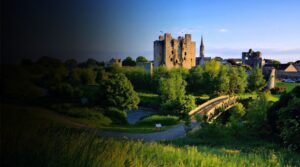
Trim Castle in County Meath is the single best surviving example of Norman military ambition in Ireland. Built by Hugh de Lacy starting in the late 12th century, its enormous cruciform keep — twenty sides arranged in a cross shape — was designed to eliminate blind spots for defenders, an innovation few other Irish castles matched. Trim dominates the River Boyne and the town that grew up around it, and its scale alone tells you how seriously de Lacy took holding Meath against both Gaelic resistance and rival Norman lords. The castle took decades to complete, and its scale has made it a popular filming location for productions looking for an authentic medieval backdrop.
Carrickfergus Castle and Norman Ulster
While most Norman expansion concentrated on Leinster and Munster, Carrickfergus Castle in County Antrim shows the Normans pushing into Ulster as well. Built by John de Courcy following his own private invasion of Ulster in 1177, Carrickfergus commands a rocky promontory over Belfast Lough and remained a strategically vital fortress for centuries afterward, seeing action as recently as the 17th century. It stands today as one of the best-preserved Norman castles anywhere in Ireland or Britain, having survived sieges, changes of ownership, and centuries of continued military use long after most other Norman fortresses had been abandoned.
The Anglo-Norman Lords and Their Legacy
Names like de Lacy, de Courcy, Fitzgerald, and Butler dominate Ireland’s Norman-era history, and many of their descendants — the Butlers of Kilkenny among them — remained powerful Irish landowning families for centuries after the initial invasion, gradually adopting Irish customs, language, and even alliances in a process historians call becoming “more Irish than the Irish themselves.” Their castles, in many cases, stayed in continuous use and adaptation for six or seven hundred years, evolving from military strongholds into family seats and eventually, in several cases, into the castle hotels of today. That continuity is rare in European history, where invading families more often lost their footholds within a century or two.
Norman Castles in the Ancient East
Ireland’s Ancient East region carries the highest concentration of significant Norman sites in the country, largely because it was the first region conquered and settled. Trim, Kilkenny, and Ferns Castle all sit within this corridor, alongside dozens of smaller tower houses built by lesser Norman families across the following centuries. This concentration is exactly why the region remains the richest ground in Ireland for tracing the Norman story from first landing to lasting settlement, and it’s possible to visit several major sites from this era within a single day’s travel.
How Norman Castles Shaped Irish Towns
Many of Ireland’s oldest towns — Kilkenny, Trim, New Ross, Carrickfergus among them — grew up directly around Norman castles, following a deliberate pattern of walled towns built for trade and defence under a castle’s protection. Street layouts, town walls, and even market square positions in these towns often still trace back to Norman-era planning decisions made 800 years ago, making a walk through their old quarters a walk through Norman urban design as much as Norman military history. Even street names in some of these towns still echo their medieval trade guilds and gatehouses.
Decline and Adaptation: From Fortress to Home
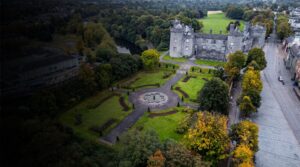
By the 15th and 16th centuries, as Gaelic and Anglo-Norman power balances shifted and firearms made traditional castle defences less effective, many Norman-era castles were adapted rather than abandoned — extended with more comfortable living quarters, softened with larger windows, or eventually left to decay once families moved to newer houses nearby. This slow transition from fortress to residence to ruin is written into the very architecture of sites like Kilkenny Castle, where medieval defensive stonework sits alongside later Victorian-era additions, making it possible to read several centuries of changing priorities in a single building.
Visiting Ireland’s Norman Castles Today
Seeing the full arc of Norman castle-building — from grassy motte mounds to Trim’s towering keep to Kilkenny’s later transformation — takes more than a single stop, and most of the best sites sit outside major cities with limited public transport connections. A private driver-guide who can trace that 800-year story across several sites in a single day turns disconnected ruins into one coherent narrative, connecting a grassy motte mound to a soaring keep to a converted family seat in a way that’s hard to piece together from a guidebook alone. Norman history features heavily throughout Ireland’s Ancient East Castle Experience and Ireland’s Legendary Castle Trail — see the full Castle Tours lineup to plan a route.